
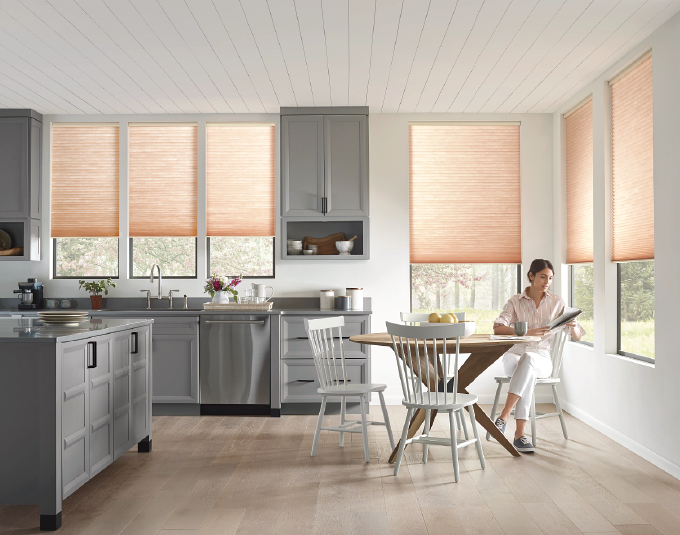
They’re simple, yet elegant. They’re sleek, offer great privacy benefits and can also help control the amount of daylight that enters a specific area during various parts of the day.It’s easy to see why cellular shades, also known as “honeycomb shades,” are among the most popular window treatments available today. But arguably the biggest benefit of cellular shades is their energy efficiency benefits. In this post, we’ll further discuss the energy performance of cellular shades, one of the key benefits that have made this type of window treatment so popular.
Cellular Shades: Exceptional Insulation
Of all window treatments on the market today, cellular shades have the highest R-values. R-values help measure a particular material’s resistance to conductive heat flow. The higher the R-value, the better the insulator. The high R-value is largely due to how cellular shades are designed. Most cellular shades consist of pleated materials that fold up, similar to an accordion, typically near the top or the bottom of the window they’re installed on. Insulated versions even include one or more layers in honeycomb-like cross-sections, which help enhance energy performance and reduce heat conductivity.
While standard cellular shades offer good energy performance, insulated versions take it to a whole new level, making these types of treatments an ideal choice for homes and offices that are looking to increase comfort and resale value, and decrease energy costs. Cellular shades that run on sidetracks tend to be the most energy-efficient styles. Other value-added optional features, like automation, can be included so that the shades open and close at a set schedule to maximize and control the amount of daylight that enters the room.
Just how much of a difference can cellular shades make? In cold periods of the year, shades that are installed correctly can reduce heat loss by about 40 percent on average — representing about a 20 percent energy savings. Even in warm periods of the year, cellular shades still play an important role. Specifically, they can help reduce unwanted solar heat through windows, reducing the gain to 15 percent or less when installed correctly. This doesn’t just help reduce energy bills, but it can also reduce wear and tear and help extend the longevity of HVAC systems.
Optimizing Cellular Shades in Hot and Cool Seasons
Did you know cellular shades perform in various seasons of the year? Keep in mind that during the winter months, heat is trying to escape through the windows. In the summer months, the sun’s rays can heat your home through the windows.
Cellular Shades in the Summer
In the summer cooling season, when air conditioners are on and running to help maintain a comfortable indoor temperature, cellular shades can help represent up to a 25 percent savings in energy costs if they’re coupled with other features. For instance, shades are most efficient if all the windows in a property are covered with them and when integrated controls, like smart thermostats, are also on hand to help manage the indoor temperature. Compared to Venetian blinds, cellular shades that are installed and managed properly can represent up to 15 percent greater energy savings.
Cellular Shades in the Winter
During the winter months when the furnace is operating to heat properties is where cellular shades truly shine. When these shades are down, they act as excellent insulators on windows, preventing heat from escaping properties through one of the key exit points. They can also help reduce any drafts that may be coming from the windows. Again, automated controls and smart thermostats can help take the efficiency of cellular shades to new levels of energy performance when utilized correctly in any type of property.
It’s estimated that about 80 percent of all households in the United States have some sort of window treatment. However, the vast majority of these treatments are low-efficiency coverings. For property owners looking to enhance energy performance and limit the wear and tear on HVAC units, cellular shades are an ideal upgrade option. On a very basic level, they offer exceptional energy efficiency properties — and these features can be further enhanced with the use of automated controls and smart thermostats.